
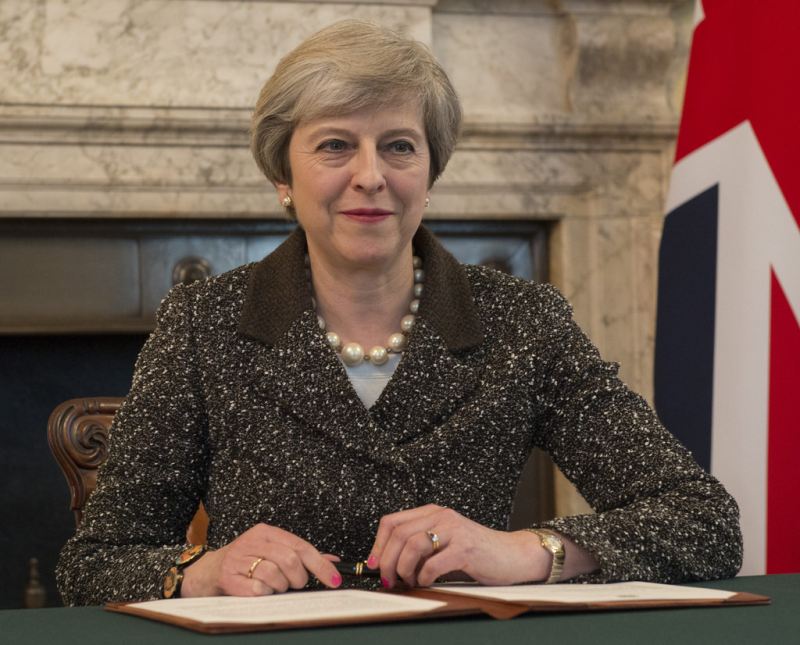
There are moments in public life when the words spoken become part of the historical record.
The triggering of Article 50 was one of those moments.
A year earlier, most people in the UK had never heard of Article 50. Yet when the Prime Minister formally announced the Government’s decision to invoke it, the country crossed a constitutional threshold no nation had crossed before. It was a moment of enormous consequence, and naturally, expectations for the speech were high.
Politics aside, it’s worth examining how such a significant announcement was delivered. Not the policy, not the debate, but the communication itself: the tone, structure, and presence of the speaker at the centre of it.
Last summer, I wrote about Theresa May’s speaking style during the leadership contest. I noted then that she was confident and controlled but often sounded as though she were “going through the motions.” With Article 50, the stakes were far higher. So how did she approach it?
The Commander
Every speaker has a default style. Theresa May’s is the Commander: direct, firm, and unambiguous.
She opened the Article 50 statement in exactly that mode:
The first minute was decisive. No preamble, no softening. The message was clear: the decision had been made, and the process had begun. For an announcement of this magnitude, clarity was essential, and she delivered it with characteristic control.
The Facilitator
A speech of this nature couldn’t rely solely on authority. The country was divided, emotions were high, and the moment required more than instruction. So, she shifted subtly but deliberately into the Facilitator style:
Here, the tone softened. The language broadened. She acknowledged uncertainty and invited the country to look forward with “optimism and hope.” It was a necessary modulation: a nod to unity without abandoning her core firmness.
The Analyst
A speech of this scale also needed substance. The world was listening for detail, not just direction.
This is where the Analyst emerged. She outlined the practical implications of triggering Article 50, the Government’s priorities, and the framework for negotiations. It wasn’t emotional, but it was structured, a deliberate attempt to anchor the announcement in facts rather than rhetoric.
The Motivator
Motivation is not Theresa May’s natural register, but she reached for it in her closing:
The intention was clear: to lift the speech from procedure to purpose. To offer a sense of collective endeavour at a time when the country felt anything but united.
A Balanced, Carefully Constructed Speech
Given the complexity of the moment, the speech was crafted to offer something to everyone: clarity for those who wanted decisiveness, reassurance for those who felt uncertain, and a call for unity for those who feared division.
It was a difficult balance to strike, and the structure reflected that challenge.
Where the Speech Could Have Gone Further
Even in a carefully calibrated speech, there were opportunities to strengthen the delivery:
- Less reliance on notes
- More eye contact
- Greater physical openness
- A few more pauses to let key points land
- A touch more expressiveness
- A little more warmth and personality
These are not criticisms of content, but observations about presence, the human dimension that often determines whether a speech becomes memorable or simply functional.
Understanding Your Own Style
The four styles: Commander, Facilitator, Analyst, Motivator — appear in every workplace, every boardroom, and every presentation. Most speakers lean heavily on one. The most effective way to learn is to blend them.
If you would like to learn a little more about the 4 presentation styles referred to in this article and even find out which is your preferred style take our style quiz here:.
https://mindfulpresenter.com/review-centre/style-quiz/
Watch Theresa May’s article 50 speech here:
If this moment in political history has reminded you how important communication is, especially when the stakes are high, you may find value in our presentation training and public speaking coaching.
– Book yourself onto a powerful public speaking course.
– Invest in some really good one to one public speaking coaching.
– Get yourself some excellent presentation training
Image Courtesy of: Flickr.com

Leave a comment
You must be logged in to post a comment.