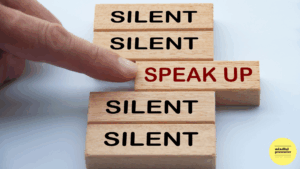
Have you ever walked away from a conversation wishing you’d spoken up, not to win, not to argue, but simply to honour yourself?
Stephen R. Covey once wrote that voice is the pathway to greatness.
Not volume or dominance, voice, the ability to express who you are with honesty and confidence.
At Mindful Presenter, we believe your voice isn’t something you earn; it’s something you already own. CEO or student, manager or clerk, every one of us is here to express who we are, and that expression begins the moment we choose to speak up.
Why Speaking Up Feels So Hard
People rarely stay silent because they’re introverted or shy. More often, it’s because they don’t want to make things awkward or be seen as difficult.
They worry about upsetting someone, sounding foolish, or being the only person in the room brave enough to speak. Some hold back because they fear conflict, or because they don’t want to look needy, demanding or unprepared. Others stay quiet simply because they don’t want to risk damaging a relationship or being labelled as the problem.
These aren’t personality traits, they’re protective instincts and they’re far more common than most people admit.
Silence often has very little to do with personality and everything to do with the stories people carry.
Silence isn’t a lack of words
It’s a learned response shaped by fear, expectation and experience.
Speaking up isn’t about personality; it’s about permission, the permission to take yourself seriously.
Three Moments We Rarely Admit Out Loud
-
The Overloaded Employee
Your boss hands you another project with another impossible deadline.
You smile and say, “Sure, no problem,” even though you’re already stretched thin.
Inside, you’re exhausted; outside, you’re agreeable.
I’ve been that person. I stayed quiet because I believed that pleasing others was safer than being honest with myself.
-
The Struggling Student
You’re lost in class; the teacher keeps pushing for better results.
Your friends seem to understand everything, but you don’t.
You want to say, “I’m just not following this, I don’t understand,” but embarrassment wins.
I’ve been that person too.
-
The Nervous Speaker
Your boss asks you to present to the management team; it’s not the content that scares you; it’s the speaking.
You want to ask for help and admit you’re terrified, but you don’t.
I’ve lived that moment as well.
These aren’t stories about weakness; they’re stories about being human.
Where Courage Really Comes From
Courage isn’t loud, it isn’t dramatic, and it isn’t something you’re born with.
Real courage doesn’t appear in a single dramatic moment. It grows the moment you recognise that your voice has value and when you allow yourself to say what you really think, rather than what you think others want to hear. It strengthens when you’re honest about how you feel, even when those feelings are uncomfortable.
When you name what you need instead of hoping someone will guess, that’s when courage shows up. It deepens every time you share what you’ve learned along the way, trusting that your experience has weight, and it expands when you speak about what matters to you, not just what’s convenient.
It becomes unshakeable the moment you realise that your perspective counts, not because it’s perfect, but because it’s yours.
How to Know When It’s Time to Speak Up
There’s always a moment, a quiet shift inside, when you know you should speak but something stops you. It’s that familiar tightening in the chest when a comment makes you feel small or dismissed. It’s the frustration of having something valuable to say, yet convincing yourself that someone else will say it better.
The hesitation that creeps in when you fear being corrected or exposed as not knowing enough. It’s the confusion that builds when you need clarity or support but don’t want to appear demanding or difficult.
Sometimes, it’s simply the weight of feeling uncomfortable, overwhelmed or unseen, hoping someone will notice without you having to say a word.
These moments are not random; they are signals, gentle but persistent reminders that your voice is needed.
Speaking up doesn’t start with confidence; it starts with recognising these signals and choosing not to ignore them anymore.
Practical Tools You Can Use Today
These are not theories; they’re real, usable techniques that work in everyday life.
-
The 5‑Second Permission Rule
When you feel the urge to speak, act within five seconds.
Count down: 5… 4… 3… 2… 1… speak.
It interrupts fear before it takes over.
-
The “One Sentence of Truth”
You don’t need a speech, just one honest sentence.
– I’m feeling overwhelmed and need to talk about this deadline.
– I don’t understand this yet and need help.
– I’d like to share my perspective.
One sentence opens the door.
- The Body‑Before‑Voice Reset
Before speaking:
– sit or stand tall
– roll your shoulders back
– take one slow breath
– pause
– smile
Let your body lead your voice, and your voice will lead your confidence.
-
The “Name the Need” Framework
A simple structure:
Feeling → Need → Request
Example:
“I’m feeling stretched. I need clarity on priorities. Can we review what’s essential this week?”
Clear. Calm. Respectful.
-
The “Future You” Test
Ask yourself: “What would the future version of me wish I’d said right now?”
That version of you is wiser and braver.
-
The 10‑Word Boundary
If long explanations scare you, use a 10-word boundary:
- “I can’t take that on right now.”
- “I need more time to do this well.”
- “I’m not comfortable with that.”
Short. Clear. No apology.
-
Rehearse the First Line Only
Most people don’t speak up because they don’t know how to start.
So rehearse just the first line; once it’s out, the rest follows.
-
Practice with a Safe Person
Say the words out loud to someone who feels safe. Your nervous system learns: “I can survive this.”
- Build Micro‑Courage Daily
Ask for tiny things:
– a different table
– clarification in a meeting
– a repeat of something you didn’t hear
Small acts build the muscle.
-
Use Silence as a Strategy
After you speak, stop talking. Silence signals confidence, and it prevents over-explaining and apologising.
Speaking up isn’t about being bold; it’s about being honest and choosing self-respect over self-silencing
Start small, start today, and let your voice become the pathway to greatness.
Why Speaking Up Matters More Than Ever
In his TED Talk How to Speak Up for Yourself, Adam Galinsky opens with a simple truth:
“Speaking up is hard to do.”
It is hard, but it’s also essential for your wellbeing, your relationships, your career and your peace of mind.
Your voice is not an accessory; it’s your power, and the world needs to hear it.
In his TED Talk, ‘How to speak up for yourself.’ Adam Galinsky, opens up with the statement, “Speaking up is hard to do”.
Speaking up is hard, that’s true, but it’s not only important, it’s also critical to our wellbeing, peace of mind and success.
Watch Adam’s TED Talk here to see him in action.
If you’d to learn how to speak up more effectively:
– Book yourself onto a powerful public speaking course.
– Invest in some really good one to one public speaking coaching.
– Get yourself some excellent presentation training
Image: Courtesy of Canva.com

Leave a comment
You must be logged in to post a comment.