There is a moment every expert recognises, a moment that arrives without warning, often in the middle of a meeting, a pitch, or a high-stakes presentation.
Someone leans forward, frowns slightly, and says the words that can make even the most seasoned professional tense: “Can you explain that simply?”
For people who work in worlds built on precision, finance, engineering, technology, science, and law, that request can feel like a threat. Not because they can’t explain it, but because they fear what simplicity might imply. They worry that clarity will be mistaken for superficiality, that reducing the language will diminish the value, and that removing the detail will undermine credibility.
So, they do what feels safer, they add more, more data, terminology, diagrams, context. and more justification. In doing so, they unintentionally make the message heavier, slower, harder to follow, and easier to forget.
The tragedy is that complexity rarely protects expertise; more often, it hides it. The moment your audience has to fight to understand you, they stop listening and start surviving.
The quiet myth that keeps experts trapped
There is a belief that circulates quietly in professional environments: complexity signals intelligence, and simplicity signals a lack thereof. It’s a belief that pushes people to speak in ways that impress their peers but alienate everyone else.
Yet the truth is far more interesting; simplicity is not the absence of intelligence, it’s what intelligence looks like when it’s distilled, refined, and fully understood.
A scientist who can explain gene editing without losing accuracy is not “dumbing it down”; they’re demonstrating mastery. A cybersecurity specialist who can describe a threat model without drowning people in acronyms is not simplifying the work; they’re simplifying the experience of understanding it.
When a financial analyst articulates risk without a spreadsheet, they are not removing sophistication; they’re revealing it.
Simplicity is not a downgrade; it is a revelation
Why simplicity feels dangerous when your world is complex
Experts don’t struggle with simplicity because they lack clarity.
They struggle because they see the entire landscape, the dependencies, exceptions, architecture, data, and the nuance. They live inside the detail, and they know the consequences of getting it wrong. Experts understand the weight of the decisions being made.
So, when someone asks for simplicity, it can feel like being asked to amputate something essential, but simplicity is not the removal of complexity; it is the intelligent sequencing of it.
It’s the courage to say, “Here is what matters first.”
The moment simplicity becomes powerful
Something remarkable happens when a complex idea is expressed with clarity: people stop trying to decode the message and start engaging with it. A simple explanation does not make an idea smaller; it makes the audience larger.
Imagine an engineer explaining a system redesign to a non-technical board. If she starts with the architecture diagram, she loses their interest. If she begins with the impact, like “We’re redesigning the system so it stops breaking under pressure and can support future growth,” she captures their attention.
Think of the scientist presenting clinical data. If he starts with the methodology, he overwhelms his audience. If he begins with the meaning, “This treatment helps people recover faster with fewer complications,” he gains their trust.
Think about the finance director explaining a risk model; if she starts with the equations, she frightens her audience. If she begins with the purpose, “We’re preparing for the storms most likely to affect us”, she gains their trust.
Simplicity is not the removal of depth; it is the creation of access.
How experts make the complex simple without losing credibility
The professionals who excel at simplicity do not hide complexity; they manage it.
They begin by naming the truth: “This is a complex system with a lot of moving parts. Let me give you the clear, high level picture first, and then we can go into as much detail as you need.”
They separate what the audience must know from what they can ask for. “There are three things you need to understand to make this decision. Everything else is supporting detail, which I can walk you through if you’d like.”
Experts who make the complex simple without losing credibility show that simplicity is not a shortcut but a choice.
“We’ve simplified the explanation, not the risk. Here’s how we’ve modelled the worst case scenarios.”
This is how you maintain trust while making things easier to understand. You don’t pretend the complexity isn’t there; you simply refuse to lead with it.
Simplicity as a discipline of leadership
Simplicity is not a rhetorical device. It is a discipline that requires clarity of thought, emotional intelligence, and respect for the audience.
Simplicity needs you to decide what truly matters and to let go of the need to prove how much you know. It requires you to prioritise understanding over performance, and it requires you to remember that communication is not about displaying expertise; it is about transferring it.
The professionals who rise, the ones who get trusted with bigger decisions, who influence strategy, and shape culture, are rarely the ones who sound the most complicated. They are the ones who make the complex feel graspable without ever insulting the intelligence of the people in front of them.
That is the art of intelligent simplicity; it’s the work of mastery
If mastering this discipline matters to you, you may find that developing your ability to simplify complex ideas becomes far easier when you practise in a structured, supportive environment. Our Presentation Skills Training programme is designed precisely for professionals who need to communicate intricate concepts with clarity and confidence.
For those who prefer a more personalised approach, Public Speaking Coaching offers the space to refine your thinking, sharpen your message, and learn how to translate complexity into compelling clarity. And if you’re looking for a deeper, immersive experience, our public speaking course provides a powerful foundation for communicating with impact in high‑stakes situations.
These are not detours from the work of simplicity; they are extensions of it
Simplicity is not the art of making something smaller; it is the art of making something clearer. It is the moment when expertise becomes generosity, when knowledge becomes connection, and when communication becomes leadership. In a world overflowing with noise, the ability to express something complex with grace is no longer a luxury; it is a strategic advantage. When you choose simplicity, you choose influence. When you practise it, you elevate everyone around you.
If this piece resonated with you, or if you know someone who struggles to explain complex ideas, please share it with them. Every time one more professional learns to communicate with clarity, the world becomes a little easier to understand.
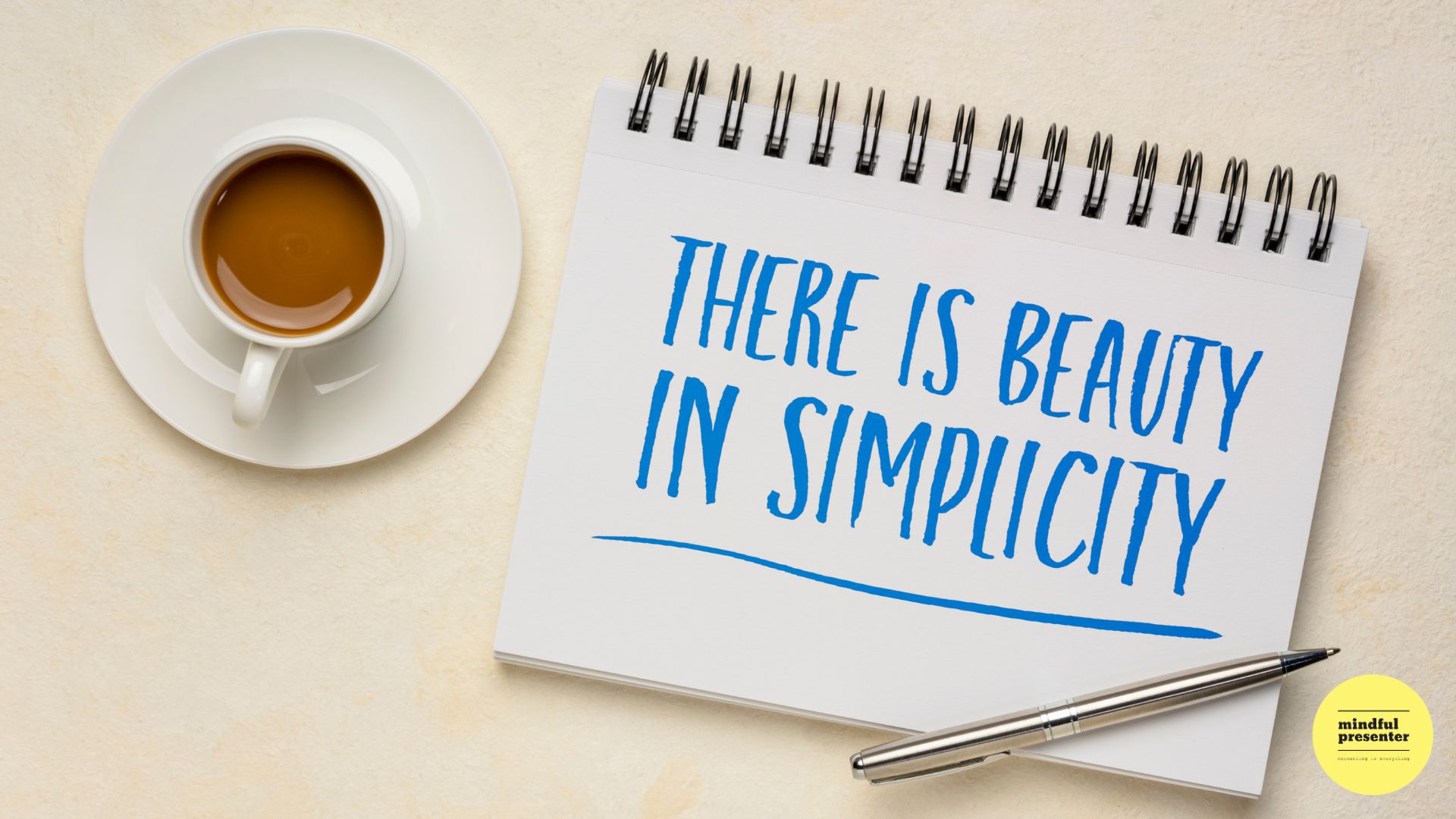
Image courtesy of Canva.com
